Saturday, 14 September 2013

Rosa Mystica, Pray for us

Mary, my Mother, thanks for this day. I enjoyed the Rosaries we prayed in front of the Rosa Mystica statue and the procession that followed. The ambience provided by Nature – the green paddy field, the white birds (egrets), the elongated pond and even that big butterfly with its black and yellow wings hugging those red shoe flowers -   really made me think of your apparitions in Cova da Iria, Lourdes, Medjugorje hills and of course, the little village of Montichiari with its suburb Fontanelle    I enjoyed praying the Litany – four times!!! – as I have never done before! Though the candle in my hands blew off in the wind, the flame that you lit in my heart still remains fresh. Thank you dear Mother for this wonderful day! Today is the feast of the Exaltation of the Holy Cross of Your Beloved Son. How blessed do I feel to have spent this day at your feet.  
Let me here mention one of my favourite websites,  where we can view the beautiful illustrations and explanations of the Litany of Loreto.
 http://campus.udayton.edu/mary/prayers/rosamystica.html, Let me quote from this site here : 
The Marian Library has in its possession rare books of the eighteenth century with engravings by the renowned Augsburg artist, Josef Sebastian Klauber (ca. 1700-1768). The highly symbolic and illustrative reproductions are typical of the Baroque period. Their message is of great spiritual riches. Mary's profile is that of the exalted Mother, Virgin, and Queen, as suits the period. We limited ourselves to the illustrations of the Marian titles. The reader needs to keep in mind that the titles introduced in the nineteenth and twentieth centuries, obviously, are not included in Klauber's illustrations.
Below is the illustration of Mystical Rose and its explanation 
Rosa Mystica
Mystical Rose
Mary is compared to the mysterious (mystical) rose. The rose was symbol of mystery (antiquity), and for early Christians a metaphor of both martyrdom (Cyprian) and paradise (catacombs of Saint Callistus).  The half image of Mary in this illustration emerges from a giant rose bush planted in a French garden.  Two potted rose trees flank the central image.  All three serve as visual support to the scriptural references of the rose symbolism applied to Mary.
The rose bush with open petals serving as throne of Our Lady bears the following caption: “Open up your petals like roses planted near running water” (Sirach 39:13).  The lateral rose trees make reference to the “rosebush in Jericho” (Sirach 24:14) and to the “blossoms on the branches in springtime” (quasi flos rosarum) (Sirach 50:8).  The immediate reference of these three rose metaphors is the children of God, Wisdom, and Simon, Son of Jochanan.  They are also applied to Mary in order to highlight Mary’s sinlessness and role in the Incarnation. Indeed, she is “rose without thorn” (since Sedulius Caelius, ~ 430) and the shoot (Mary) of the root (Jewish people) from which a “bud shall blossom” (Jesus) (see Isaiah 11:1 – since Tertullian, Ambrose).  Mary’s mystery is that of her virginal motherhood.  The invitation of the lemma: “Let us crown ourselves with rosebuds” (Wisdom 2:8) is addressed to all.  We are called to be sons and daughters of God.
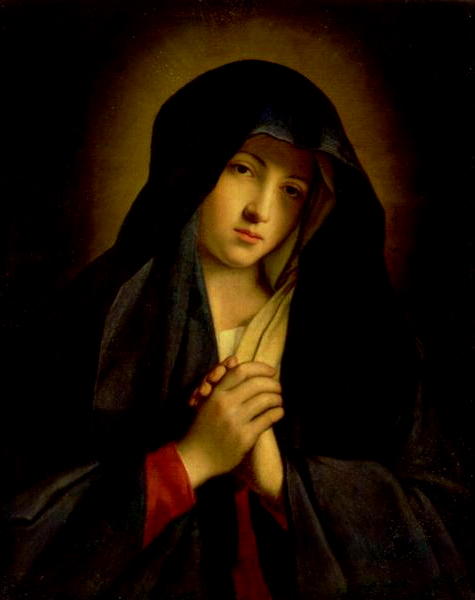
Mother dearest, tomorrow is your feast , the feast of your Seven Dolors. 

Mary, surrounded by the Seven Sorrowshttp://en.wikipedia.org/wiki/Our_Lady_of_Sorrows

Hail, Mater Dolorosa
File:The Madonna in Sorrow.jpg
The Madonna in Sorrow byGiovanni Battista Salvi da Sassoferrato, 17th century
Let me pray the last verses of Stabat Mater here:
Be to me, O Virgin, nigh,
lest in flames I burn and die,
in His awful Judgment Day.
Christ, when Thou shalt call me hence,
be Thy Mother my defense,
be Thy Cross my victory;
While my body here decays,
may my soul Thy goodness praise,
Safe in Paradise with Thee.


Thursday, 12 September 2013

Some quotes on Humility, the most difficult of all virtues

Humility is the most difficult of all virtues to achieve; nothing dies harder than the desire to think well of self."-- T.S. Eliot (in "Shakespeare and the stoicism of Seneca")
Virgin Mary wallpapershttp://www.gadel.info/2011/07/blessed-virgin-marys-photos-and.html

 I liked these lines from Fr.John's E-newsletter from St.Anthony Shrine , Cincinaci today:
St. Anthony placed humility as the root of all other virtues.  Humility defined St. Anthony.  It was at the very center of his way of thinking and acting.  In one of his sermons, St. Anthony wrote, “Just as the root feeds the tree, so humility feeds the soul.”
What is humility?  The word comes from the Latin word, humus, which means ground, earth, soil.  Thus humility means being grounded.  It means remembering that “we are dust and unto dust we will return.”  Pride makes us want to be looked upon as better than others.  Humility makes us realize that we are no better nor no worse than what we really are.  Humility enables us to know our strengths and our weaknesses.  It helps us understand that our strengths are gifts from God.  It helps us to accept that we also lack talents that others have.  As St. Anthony put it, “Attribute to God every good that you have received.  If  you take credit for something that does not belong to you, you will be guilty of theft.”
...  Humility means that we understand that life is like a game of cards.  Some people have been dealt a better hand of cards to play the game of life with than have others.  We can’t take the credit for having had good parents, having had good influences in our lives when we were young, and receiving the opportunity for a good education.  These and so many other things were blessings given us, not things we accomplished on our own.


...  If we are full of ourselves and full of pride, there is little room for God in our lives.  If we are full of ourselves and full of pride, there is little room for other human beings in our lives.  Jesus teaches us that our two most important obligations in life are to love God and to love our neighbor.  We cannot love God and neighbor if we are too in love with ourselves.  Through the intercession of St. Anthony may we learn to become more humble.
Humility is the most difficult of virtues, but is the most precious too! St. Theognostos says thus : 
62. I shall tell you something strange, but do not be surprised by it. Should you fail to attain dispassion because of the predispositions dominating you, but at the time of your death be in the depths of humility, you will be exalted above the clouds no less than the man who is dispassionate. For even if the treasure of those who are dispassionate consists of every virtue, the precious stone of humility is more valuable than them all: it brings about not only propitiation with the Creator, but also entry with the elect into the bridal chamber of His kingdom. St. Theognostos - On the Practice of the Virtues in Philokalia Volume II

http://www.christianbook.com/philokalia-christian-spiritual-selections-annotated-explained/allyne-smith/9781594731037/pd/473109

Humility is strong--not bold; quiet--not speechless;sure--not arrogant. -Estelle Smith

Wednesday, 11 September 2013

On my First Reading of 'Lumen Fidei'

Do you need to be told that whatever has been, can still be?- T.S.Eliot
LUMEN FIDEI encyclical provisional cover_ B 13.indd
http://truthpouredout.com/2013/07/lumen-fidei/

I am totally entranced reading the first encyclical of Pope Francis, "Lumen Fidei". In fact, it is a Pope Francis and Pope Emeritus Benedict XVI co authored encyclical. “Wow!” is all I can say of this little but profound book! It starts with a brief discussion on the erroneous teachings of the existential and atheistic think tanks of the last two centuries that faith is something that belongs to darkness. The Soren Kierkegard phrase “leap of faith” is mentioned , so also is Nietzsche’s advice to his sister Elizabeth, encouraging her “to take risks,  to tread new paths … with all the uncertainty of one who must find his way " because according to him “this is where humanity’s paths part: if you want peace of soul and happiness then believe, but if you want to be a follower of truth , then seek”. The Encyclical thus enlightens us of the fallacy of the so called existential thought pattern, how that had criticized Christianity as having dimmed the fullness of human existence, “stripping life of novelty and adventure.”Nietzsche condemned faith as an “illusion of light, an illusion which blocks the path of a liberated humanity to its future.”
Here the Popes take their stance on faith, that Faith is a Light by itself. 
It is not illusory, it is real. Faith is a light that can illuminate. “We come to see that faith does not dwell in shadow and gloom; it is a light for our darkness. Dante, in the Divine Comedy, after professing his faith to Saint Peter, describes that light as a “spark, which then becomes a burning flame and like a heavenly star within me glim-mers”. It is this light of faith that I would now like to consider, so that it can grow and enlighten the present, becoming a star to brighten the horizon of our journey at a time when mankind is particularly in need of light."
 How inspiring,  how exalting!!!! 
   In section 13, there is an elaboration on what Faith is not. The description of idolatry, which is the flip side of Faith , is an extraordinary passage I must say. Let me quote,
  The history of Israel also shows us the temptation of unbelief to which the people yielded more than once. Here the opposite of faith is shown to be idolatry. While Moses is speaking to God on Sinai, the people cannot bear the mystery of God’s hiddenness, they cannot endure the time of waiting to see his face. Faith by its very nature demands renouncing the immediate possession which sight would appear to offer; it is an invitation to turn to the source of the light, while respecting the mystery of a countenance which will unveil itself personally in its own good time. Martin Buber once cited a definition of idolatry proposed by the rabbi of Kock: idolatry is "when a face addresses a face which is not a face".[10] In place of faith in God, it seems better to worship an idol, into whose face we can look directly and whose origin we know, because it is the work of our own hands. Before an idol, there is no risk that we will be called to abandon our security, for idols "have mouths, but they cannot speak" (Ps 115:5). Idols exist, we begin to see, as a pretext for setting ourselves at the centre of reality and worshiping the work of our own hands. Once man has lost the fundamental orientation which unifies his existence, he breaks down into the multiplicity of his desires; in refusing to await the time of promise, his life-story disintegrates into a myriad of unconnected instants. Idolatry, then, is always polytheism, an aimless passing from one lord to another. Idolatry does not offer a journey but rather a plethora of paths leading nowhere and forming a vast labyrinth. Those who choose not to put their trust in God must hear the din of countless idols crying out: "Put your trust in me!" Faith, tied as it is to conversion, is the opposite of idolatry; it breaks with idols to turn to the living God in a personal encounter. Believing means entrusting oneself to a merciful love which always accepts and pardons, which sustains and directs our lives, and which shows its power by its ability to make straight the crooked lines of our history. Faith consists in the willingness to let ourselves be constantly transformed and renewed by God’s call. Herein lies the paradox: by constantly turning towards the Lord, we discover a sure path which liberates us from the dissolution imposed upon us by idols.
Here is another paragraph - Para 58- where the Pope gives us the proper direction on how to look at suffering with Faith.
Nor does the light of faith make us forget the sufferings of this world. How many men and women of faith have found mediators of light in those who suffer! So it was with Saint Francis of Assisi and the leper, or with Blessed Mother Teresa of Calcutta and her poor. They understood the mystery at work in them. In drawing near to the suffering, they were certainly not able to eliminate all their pain or to explain every evil. Faith is not a light which scatters all our darkness, but a lamp which guides our steps in the night and suffices for the journey. To those who suffer, God does not provide arguments which explain everything; rather, his response is that of an accompanying presence, a history of goodness which touches every story of suffering and opens up a ray of light. In Christ, God himself wishes to share this path with us and to offer us his gaze so that we might see the light within it. Christ is the one who, having endured suffering, is "the pioneer and perfecter of our faith" (Heb 12:2).
            In the concluding pages of the encyclical, the author/s even quote from T.S. Eliot's pageant play, 'The Rock' 

Do you need to be told that even such modest attainments
As you can boast in the way of polite society
Will hardly survive the Faith to which they owe their significance?


Let me also conclude my thoughts here, quoting from the Chorus of 'The Rock' by T.S.Eliot:
  
Light
Light
The visible reminder of Invisible Light.
Be not too curious of Good and Evil;
Seek not to count the future waves of Time;
But be ye satisfied that you have light
Enough to take your step and find your foothold.
O Light Invisible, we praise Thee!
Too bright for mortal vision.

Tuesday, 10 September 2013

Inspired by my Angel to become versed in Sacred Art !

I saw the angel in the marble and carved until I set him free.
Michelangelo 

                                                                    http://www.carmelpublications.com/losservatore.html
I realize today with an enigmatic joy that what I discover each day is not something that I discover on my own. In fact it is what my Guardian Angel has been guiding and leading me into. This realization came upon me this morning as I sat down on my prayer chair. But before I could reflect or meditatate, my eyes suddenly beheld a folded tabloid-sized paper still unwrapped within its postal cover. What I could decipher on taking it out of the wrap was that it was an old issue of L'OSSERVATORE ROMANO, the Malayalam edition,  dated 19 August, 2010.It is the Pope's in-house paper, the semi official news paper of the Holy See - (published from Vatican!!).
 The paper has turned slightly yellow. But everything else in tact! On tearing open the wrap, what I read immediately is the article at the last page. It is a reflection on the theologies of East and West through  'Sacred Art'. The whole article in English is published in the net by ewtn. The link is http://www.ewtn.com/library/MARY/assumptdormi.HTM. The article is based on the paintings of Assumption and Dormition of Mary, Mother of God. The author is Christopher Longhurst and the title is Mariae Assumpta and Dormitio Mariae. Here is how Longhurst introduces the subject:

In the Western tradition the Assumption has been a subject of sacred art since writings as earlier as the fifth century bore witness to the Church's early belief in Mary's body being assumed into heaven after her earthly life. The Eastern Fathers considered another tradition closely associated with the West which taught that Mary, being free from sin and death, at the end of her earthly life simply went to sleep and was taken up into heaven. This latter tradition was known as Dormitio Mariae — the "Dormition" or "Falling Asleep" (Greek koimesis) of the Virgin. In the religious art of the West it was commonly called the Death of the Virgin, a familiar subject which draws on Byzantine models until the end of the Middle Ages. Subsequently the doctrine of Maria Assumpta(Mary's Assumption) gained headway in the West while the Dormition remained the principal theme in the East. Today the iconography of each tradition reflects how the Church has integrated its teaching on Mary's Assumption to create a force shaping the development of Mariology in the arts throughout the centuries.

Anyway, I am intrigued. The first thing I am going to do about this is to renew my subscription of L"osservatore Romano. Next I am going to study a bit deeper into this subject, especially about Sacred Art! Something I can really study along with the three pillars, Sacred Word, Sacred Tradition and Sacred Magisterium. I think Sacred Art too can go along with these Sacred pillars.

The Byzantine paintings are something that I got fascinated with, while I made my Jerusalem pilgrimage. I also remember standing a bit too long beside the Dormition statue of Our Lady at the Church of Dormition. This beautiful statue of Virgin Mary asleep,is in the crypt of the church and it sure is a serene place for prayer.  


Thanks my dear Guardian dear, you are an Angel!! I am reminded of the Angel whom St.John the Evangelist encountered at Patmos, where the Book of Revelation was written. I shudder when I think of the voice of the Angel in Rev 5:1-2!
Saint John on Patmos - Limbourg brothers
Saint John on Patmos - Limbourg brothershttp://www.wikipaintings.org/en/search/saint%20john%20the%20evangelist%20guido%20reni/5
                                            

 I saw that in the right hand of the One sitting on the throne there was a scroll that was written on back and front and was sealed with seven seals.  Then I saw a powerful angel who called with a loud voice, 'Who is worthy to open the scroll and break its seals?' - Revelation 5:1-2

I Believe in Angels.......

Make yourself familiar with the angels, and behold them frequently in spirit; for, without being seen, they are present with you. ~St Francis of Sales


O welcome, pure-eyed Faith, white-handed Hope,Thou hovering angel, girt with golden wings!
~John Milton, Comus
Youth Guardian Angel.
http://frontiernowimages.com/Guardian-Angel-Images.html

Today I discover with awe the presence of my Guardian Angel , guiding me, leading me, inspiring me. Thanks dear Angel. I now realize that it is you, my constant companion, the great gift God has bestowed upon me, who has inspired me to read and study about the three Pillars of the Catholic Church. I came upto this realization when I browsed through the Opus Angelorum site. Even that browsing too was not a coincidence. Divinely inspired it is, I'm so sure.The very first step mentioned as a practical way to grow together with the Angel is to study and meditate about "the uniqueness of the Church and its Magisterium"!!! Below do I quote all the  seven steps , the practical counsels for growing with my Angel. 

Practical Counsels For Growing Together With Your Angel

http://www.opusangelorum.org/English/Friendship.html
Here are seven practical suggestions. Inasmuch as practical, their efficacy depends on being put into habitual practice.
1. Cultivate a great esteem for the ultimate truths of the Faith: the absolute sovereignty of God, the universal mediatorship of Jesus Christ, the uniqueness of the Church and its Magisterium, and the real presence of Christ in the Blessed Sacrament. All knowledge depends upon its reduction to first principles; all virtuous action depends upon prior knowledge. These are the first principles of the Faith which should inspire all our actions. This exercise disposes us for the Gift of Understanding.
2. Make of everything you do a sacrifice of love for GOD. Consciously live your baptismal vows, your consecrations to Our Lord and His Mother. Live and renew your alliance with your Guardian Angel, ordering all things to the glorification of the Most Holy Trinity. This exercise will dispose us for the Gift of Wisdom.
3. Conscientiously form and purify your conscience according to the guiding light of the Magisterium of the Church. Be prompt in the execution of your duties, particularly those of your state and station in life. If we are faithful in little things, greater gifts and lights will be given to us. The works of mercy are also particularly appropriate to disposing ourselves in docility to the Gift of Counsel.
4. Order your 'steps' in the footsteps of Our Lord. On the tomb of a Prior of the Order of Holy Cross was written the epitaph: "He never took a step that was not directed to the honor of God." When exhumed, they discovered that his legs were incorrupt. This may seem easy, but it is the battle against character faults, habitual venial sin, concessions to comfort, to human respect. It is the path of sincere self-discipline in which we never lose sight of the goal nor take any illicit detours. We cannot deviate from the example of Christ without losing the hand of the Angel. Hence, those who are shy of sacrifice will never develop a deep friendship with their Angel. The Cross looms on the horizon of this counse, which disposes us for the Gift of Science, the science of the Life of Christ.
5. Make an effort to be genuinely kind and patient. Kindness is the trait of generous love that willingly exceeds the demands of justice. Hence, it is a divine virtue. Patience, 'hard thing,' is literally the willingness to suffer. The LORD said to St. Catherine of Siena: "Divine charity is so closely joined in the soul with perfect patience, that neither can leave the soul without the other. For this reason (if the soul choose to love Me) it should choose to endure pains for Me in whatever mode or circumstance I may send them. Patience cannot be proved in any other way than by suffering, and patience is united with love as has been said" (Dialogues, 'On Providence'). Since the Angel is commissioned to lead us to perfection, there can be no sustained collaboration nor any significant intimacy with him except we be resolved to cultivate these virtues in us, which dispose us for the Gift of Fortitude.
6. Walk constantly in the presence of God and your Angel. This cultivates in us the habit of recollection, of holy reverence. Only those who are habitually aware of the presence of God can spontaneously judge all things in the light of eternal values. This state of recollection, the foundation of the spiritual life, is an habitual state of contact, of conversation with the Guardian Angel. To acquire it we need the humility and readiness to start over hundreds of times each day. This exercise will dispose us for the Gift of the Fear of the Lord.
7. Rejoice in the Love of the Father, in Christ's personal love for you, in the sanctifying, loving presence of the Holy Spirit. Reflect frequently upon our Lord's love for you, upon His insatiable thirst to be able to communicate Himself more perfectly to you. Let your heart be enkindled with the Love of Mary, your Mother, and the love of your Guardian Angel. Consider that only you can satisfy their thirst for your love. There are no substitutes for a flaming heart. It cannot be held back, it will accomplish great works in the fiery love of the Gift of Godliness.

We should pray to the angels, for they are given to us as guardians.  ~St Ambrose

Sunday, 8 September 2013

The Three Pillars of the Catholic Church Authority.

What I am discovering today  (though a bit too late for my age !!!) is about the three strong pillars of the Catholic Church's Authority - 
Sacred Scripture, Sacred Tradition and Sacred Magisterium . 

WHAT WE BELIEVE:

THE 3 PILLARS OF CATHOLIC CHURCH AUTHORITY

Sacred Scripture- All books of the Old Testament and the New Testament.

Apostolic Tradition- The living tradition of the Church, the Church Fathers, the Sacred Liturgy.

The Living Magisterium- The teaching authority of the Pope and all Bishops  worldwide who are united with him.
http://www.sabecorse.net/whatwebelieve.htm


2 Thessalonians 2:15: So then, brethren, stand firm and hold to the traditions which you were taught by us, either by word of mouth or by letter.

Sacred Tradition does NOT refer to individual practices and customs, such as the language of the Mass, kneeling or standing for Holy Communion, eating or not eating meat on Friday, etc.  Rather, it is the oral teaching of Jesus Christ handed on to the Apostles and the Church, which carries equal weight with the Church's book, the Bible.  Here is what "Dei Verbum", or the "Word of God" document from Vatican II has to say about Sacred Tradition:
"Hence there exists a close connection and communication between sacred Tradition and sacred Scripture. For both of them, flowing from the same divine wellspring, in a certain way merge into a unity and tend toward the same end. For sacred Scripture is the word of God inasmuch as it is consigned to writing under the inspiration of the divine Spirit. To the successors of the apostles, sacred Tradition hands on in its full purity God’s word, which was entrusted to the apostles by Christ the Lord and the Holy Spirit.
"Thus, by the light of the Spirit of truth, these successors can in their preaching preserve this word of God faithfully, explain it, and make it more widely known. Consequently it is not from sacred Scripture alone that the Church draws her certainty about everything which has been revealed. Therefore both sacred Tradition and sacred Scripture are to be accepted and venerated with the same devotion and reverence."
http://www.catholicbible101.com/sacredtradition.htm

THE UNITY OF SACRED TRADITION AND SCRIPTURE
Since sacred Tradition and sacred Scripture come from one and the same divine source, there is a close connection between them, both forming one sacred deposit of the word of God. One of them is not complete without the other. As the words themselves imply, SACRED SCRIPTURE is the written word of God divinely inspired by the Holy Spirit; and SACRED TRADITION is divinely guided “handing down” of that revealed truth entrusted to the apostles, and passed on written or unwritten. Hence the second Vatican Council declares:
“It is not from sacred Scripture alone that the Church draws her certainty about everything that has been revealed. Therefore, both sacred Tradition and sacred Scripture are to be accepted and venerated with the same sense of devotion and reverence” (ibid. 9).
And since, as we have seen, Christ established a living teaching authority to interpret in His name and hand down His revealed word, the same Vatican Council concludes:
“It is clear, therefore, that sacred Tradition, sacred Scripture, and the teaching authority of the Church (the magisterium), in accord with God’s most wise designs, are so linked and joined together that one cannot stand without the others, and that all together and each in its own way under the action of the Holy Spirit contribute effectively to the salvation of souls” (ibid. 10).
http://www.rosary-center.org/ll47n4.htm
From Wikipedia :
The Catholic Church, views holy tradition as a passing down of that same Apostolic Faith, but, in a critical difference from the Eastern Orthodox position, holds that the Faith continues to deepen and mature over time through the action of the Holy Spirit in the history of the Church, and in our understanding of that Faith, all the while staying identical in essence and substance; thus the doctrine of the Trinity, the two natures of Christ, the divine motherhood, the Immaculate Conception, and Assumption of Mary, along with other central Catholic doctrines were always part of the orthodoxy of the Church, but were not precisely defined for many years, and that our understanding of them may continue to deepen, not only through mystical experience, but through the practice of the sciences ofphilosophy and theology as guided by the Holy Spirit, exemplified in the Scholastics such as Saint Thomas Aquinas, Duns Scotus, and William of Ockham of the High Middle Ages. A common metaphor used to explain this phenomenon is to think of a seed: over time, it grows into a tall oak, but its identity and essence is still the same.


96 What Christ entrusted to the apostles, they in turn handed on by their preaching and writing, under the inspiration of the Holy Spirit, to all generations, until Christ returns in glory.
97 "Sacred Tradition and Sacred Scripture make up a single sacred deposit of the Word of God" (DV 10) in which, as in a mirror, the pilgrim Church contemplates God, the source of all her riches.
98 "The Church, in her doctrine, life and worship, perpetuates and transmits to every generation all that she herself is, all that she believes" (DV 8 § 1).
99 Thanks to its supernatural sense of faith, the People of God as a whole never ceases to welcome, to penetrate more deeply and to live more fully from the gift of divine Revelation.
100 The task of interpreting the Word of God authentically has been entrusted solely to the Magisterium of the Church, that is, to the Pope and to the bishops in communion with him.

By the Magisterium we mean the teaching office of the Church. It consists of the Pope and Bishops. Christ promised to protect the teaching of the Church : "He who hears you, hears me; he who rejects your rejects me, he who rejects me, rejects Him who sent me" (Luke 10. 16). Now of course the promise of Christ cannot fail: hence when the Church presents some doctrine as definitive or final, it comes under this protection, it cannot be in error; in other words, it is infallible. This is true even if the Church does not use the solemn ceremony of definition. The day to day teaching of the Church throughout the world, when the Bishops are in union with each other and with the Pope, and present something as definitive, this is infallible. (Vatican II, Lumen gentium # 25). It was precisely by the use of that authority that Vatican I was able to define that the Pope alone, when speaking as such and making things definitive, is also infallible. Of course this infallibility covers also teaching on what morality requires, for that is needed for salvation.
A "theologian" who would claim he needs to be able to ignore the Magisterium in order to find the truth is strangely perverse: the teaching of the Magisterium is the prime, God-given means of finding the truth. Nor could he claim academic freedom lets him contradict the Church. In any field of knowledge, academic freedom belongs only to a properly qualified professor teaching in his own field. But one is not properly qualified if he does not use the correct method of working in his field, e.g., a science professor who would want to go back to medieval methods would be laughed off campus, not protected. Now in Catholic theology , the correct method is to study the sources of revelation, but then give the final word to the Church. He who does not follow that method is not a qualified Catholic theologian. Vatican II taught (Dei Verbum # 10): "The task of authoritatively interpreting the word of God, whether written or handed on [Scripture or Tradition], has been entrusted exclusively to the living Magisterium of the Church, whose authority is exercised in the name of Jesus Christ."
Taken from The Basic Catholic Catechism
PART FIVE: The Apostles' Creed IX - XII
Ninth Article: "The Holy Catholic Church; the Communion of Saints"

By William G. Most. (c) Copyright 1990 by William G. Most.
http://www.ewtn.com/faith/teachings/chura4.htm

From CCC 
The Magisterium of the Church
85 "The task of giving an authentic interpretation of the Word of God, whether in its written form or in the form of Tradition, has been entrusted to the living teaching office of the Church alone. Its authority in this matter is exercised in the name of Jesus Christ."47 This means that the task of interpretation has been entrusted to the bishops in communion with the successor of Peter, the Bishop of Rome.
86 "Yet this Magisterium is not superior to the Word of God, but is its servant. It teaches only what has been handed on to it. At the divine command and with the help of the Holy Spirit, it listens to this devotedly, guards it with dedication and expounds it faithfully. All that it proposes for belief as being divinely revealed is drawn from this single deposit of faith."48
87 Mindful of Christ's words to his apostles: "He who hears you, hears me",49 the faithful receive with docility the teachings and directives that their pastors give them in different forms.

Saturday, 7 September 2013

The Petrine vs. Marian dimensions of the Catholic Church

Our Lady of Fatima and pope
Benedict XVI prays to Our Lady in Fatima
Oops..., I'm really intrigued by the terms 'Petrine profile' and the 'Marian profile' of the Church. That led me to discover with joy some truths about  Vatican II. In all my blissful ignorance, i used to presume that the Vatican II had dimmed the devotions to Mary!!! And that was my excuse for many years for my lack of devotion to Mary. 
But today I realize with shame my total ignorance!! My error in thinking!! 
First of all, let me jot down what exactly is meant by the Petrine and the marian dimensions. As lazy as I am, I shall cut and paste some facts from my Google search: The link is: http://www.clerus.org/clerus/dati/2003-04/01-999999/05ING.html
The Petrine dimension of the Church could be succinctly expressed as the service of St Peter and his successors orientated to the building up and maintaining of the Church’s life of faith, the living of the Christian life in communion and charity, and the unity of the Church.
The Marian dimension of the Church is christological, pneumatological, ecclesiological and anthropological. Mary is the virgin made Church. She is the model of discipleship. What is said of Mary is said of the Church. 

This has led me further on to the Assent of faith , especially the Sacred Assent: The quote below is from the link: http://www.catholicplanet.com/TSM/assent-dissent.htm
 Sacred Assent

All of the infallible teachings of Sacred Tradition, Sacred Scripture, Sacred Magisterium require belief by the all the faithful, including laypersons, religious, and ordained persons. The teachings of these three pillars of the Faith are infallibly true: God himself guarantees that these teachings, properly understood, are without error, omission, or imperfection. In other words, each and every one of these teachings are true, none are false or erroneous, and nothing essential to the truth that is being expressed has been omitted, and no significant flaw or imperfection, of any relevance to that truth, is found within the truth being expressed. 
Since God himself guarantees the truth of these teachings, all the faithful are obligated, in the strictest sense, to believe what is taught. The obligation to believe each and all of the teachings of Sacred Tradition and Sacred Scripture and Sacred Magisterium is aptly called 'sacred assent.' It has also been termed 'the assent of faith' or 'theological assent.'
The Sacred Magisterium can teach infallibly in any of three ways: 
Infallible Teachings of the Sacred Magisterium - all require sacred assent
A. Papal InfallibilityB. solemn definitions of Ecumenical Councils (or of any similar gathering of the body of Bishops with the Pope)C. the ordinary universal Magisterium (also called simply the universal Magisterium)
Each teaching of the Sacred Magisterium requires sacred assent. This assent is an exercise of the theological virtue of faith, and is closely related to the theological virtues of love and hope. The faithful believe what the Church teaches out of love for God, and out of faith that the teaching of the Church is God's teaching, and out of hope for an eternal life with God. When sacred assent is lacking, faith is lacking. When sacred assent is lacking with personal culpability, the sin of heresy is present. Obstinate doubt or obstinate refusal to believe any of the teachings taught infallibly by Tradition, Scripture, or Magisterium is the sin of heresy.
The faithful are not only required to believe what the Magisterium teaches infallibly, they are also required to believe all that Tradition and Scripture teaches, even when those teachings have not been taught explicitly by the Magisterium. For the teaching of the Church includes everything taught by Sacred Tradition and Sacred Scripture. And the Magisterium itself teaches us to learn from Tradition and Scripture. The refusal to believe the teachings of Tradition and Scripture, unless such teachings have been taught by the Magisterium, is a serious heresy against the true Catholic Faith. The assent of faith must be given to all of the teachings of Sacred Tradition, Sacred Scripture, Sacred Magisterium. For all of these teachings are infallible.

Here is my discovery about VaticanII 's Marian dimension:  http://www.piercedhearts.org/jpii/addresses_speeches/1997/marian_petrine_principles.htm
  We well understand that Vatican II effected a great synthesis between Mariology and ecclesiology. The Marian Year adheres to such a synthesis and conciliar inspiration so that the Church may be everywhere renewed through the presence of the Mother of God who, as the Fathers taught, is a model of the Church.
The Council offers an enlightening interpretation of the presence of the Virgin in the divine plan of salvation. Because she is the instrument and privileged channel of the Incarnation of the Word in human nature and of his presence among us, Mary is “intimately united with the Church: the Mother of God is a figure of the Church, as Saint Ambrose had earlier taught, in the order of faith, of charity and of the perfect union with Christ” (Lumen Gentium, 63). Developing this teaching, I wrote in the Encyclical Redemptoris Mater: “ the reality of the Incarnation finds a sort of extension in the mystery of the Church – The Body of Christ. And one cannot think of the reality of the Incarnation without referring to Mary, the Mother of the Incarnate Word” (no. 5).
Mary united to Christ, Mary united to the Church. And the Church united to Mary finds in her the most refined and perfect image of its own specific mission which is simultaneously virginal and maternal. The Fathers and the Teachers of the early Church have underlined this double aspect: for example, St. Augustine brilliantly comments, Hic est speciosus forma prae filiis hominum, sanctae filius Mariae, sanctiae sponsus Ecclesiae, quam suae genitriit similem redditit: nam et nobis eam matrem fecit, et virginem sibi custodit” (Serm 195.2; PL 38:1018). The Virgin Mary is the archetype of the Church because of the divine maternity; just like Mary, the Church must be, and wishes to be, mother and virgin. The Church lives in this authentic “Marian profile”, this “Marian dimension”; thus the Council, gathering together the patristic and theological voices, both eastern and western has noted this phenomenom: “The Church, moreover, contemplating Mary’s mysterious sanctity, imitating her charity, and faithfully fulfilling the Father’s will, becomes herself a mother by accepting God’s word in faith. For by her preaching and by baptism she brings forth to a new and immortal life, children who are conceived of the Holy Spirit and born of God. The Church herself is a virgin, who keeps whole and pure the fidelity she has pledged to her Spouse. Imitating the Mother of her Lord, and by the power of the Holy Spirit, she preserves with virginal purity and integral faith , a firm hope and sincere charity” (Lumen Gentium, 64).

 Lumen Gentium, the Dogmatic Constitution on the Church, is one of the principal documents of the Second Vatican Council. This dogmatic constitution was promulgated by Pope Paul VI on November 21, 1964
Here is an excerpt from CHAPTER VIII: OUR LADY, from sections 60-65.
Mary, type or figure of the Church
By reason of the gift and role of her divine motherhood, by which she is united with her Son, the Redeemer, and with her unique graces and functions, the Blessed Virgin is also intimately united to the Church. As St. Ambrose taught, the Mother of God is a type of the Church in the order of faith, charity, and perfect union with Christ.[18] For in the mystery of the Church, which is itself rightly called mother and virgin, the Blessed Virgin stands out in eminent and singular fashion as exemplar both of virgin and mother.[19] Through her faith and obedience she gave birth on earth to the very Son of the Father, not through the knowledge of man but by the overshadowing of the Holy Spirit, in the manner of a new Eve who placed her faith, not in the serpent of old but in God's messenger without waivering in doubt. The Son whom she brought forth is he whom God placed as the first born among many brethren (Rom. 8:29), that is, the faithful, in whose generation and formation she cooperates with a mother's love.
The Church indeed contemplating her hidden sanctity, imitating her charity and faithfully fulfilling the Father's will, by receiving the word of God in faith becomes herself a mother. By preaching and baptism she brings forth sons, who are conceived of the Holy Spirit and born of God, to a new and immortal life. She herself is a virgin, who keeps in its entirety and purity the faith she pledged to her spouse. Imitating the mother of her Lord, and by the power of the Holy Spirit, she keeps intact faith, firm hope and sincere charity.[20]
But while in the most Blessed Virgin the Church has already reached that perfection whereby she exists without spot or wrinkle (cf. Eph. 5:27), the faithful still strive to conquer sin and increase in holiness. And so they turn their eyes to Mary who shines forth to the whole community of the elect as the model of virtues. Devoutly meditating on her and contemplating her in the light of the Word made man, the Church reverently penetrates more deeply into the great mystery of the Incarnation and becomes more and more like her spouse. Having entered deeply into the history of salvation, Mary, in a way, unites in her person and re-echoes the most important doctrines of the faith: and when she is the subject of preaching and veneration she prompts the faithful to come to her Son, to his sacrifice and to the love of the Father. Seeking after the glory of Christ, the Church becomes more like her lofty type, and continually progresses in faith, hope and charity, seeking and doing the will of God in all things. The Church, therefore, in her apostolic work too, rightly looks to her who gave birth to Christ, who was thus conceived of the Holy Spirit and born of a virgin, in order that through the Church he could be born and increase in the hearts of the faithful. In her life the Virgin has been a model of that motherly love with which all who join in the Church's apostolic mission for the regeneration of mankind should be animated.