Friday, 27 September 2013

Musings on Vatican Council II Documents

Am getting interested in the Vatican II documents!!! I've never ever  cared to read it before; if at all I have seen the volumes in the college Library, I think I had always passed by ...., thinking it to be too hard a nut for me to crack!!! After all, there were other books , fiction mainly. What a fool I used to be!!!! 
But how come the Council documents are getting so very interesting these days??? There is only one answer to that and that  is Romans 10:20:  

 "... I was found by people who were not looking for me. I showed myself to those who were not asking for me."

Thank You Heavenly Father for opening my eyes to behold the rich treasures of the Catholic Church.Thank You Abba for adopting me as Your child. 


For all who are led by the Spirit of God are children of God. So you have not received a spirit that makes you fearful slaves. Instead, you received God's Spirit when he adopted you as his own children. Now we call him, "Abba, Father."For his Spirit joins with our spirit to affirm that we are God's children. Romans 8: 14 -16
 But when the right time came, God sent his Son, born of a woman, subject to the law. God sent him to buy freedom for us who were slaves to the law, so that he could adopt us as his very own children. And because we are his children, God has sent the Spirit of his Son into our hearts, prompting us to call out, "Abba, Father." Galatians 4: 4-6


  • Today more than ever ... we are called to serve man as such, and not merely Catholics; to defend above all and everywhere the rights of the human person, and not merely those of the Catholic Church. Today’s world, the needs made plain in the last fifty years and a deeper understanding of doctrine have brought us to a new situation ... It is not that the Gospel has changed, it is that we have begun to understand it better. Those who have lived as long as I have ...were enabled to compare different cultures and traditions, and know that the moment has come to discern the signs of the times, to seize the opportunity and to look far ahead. -(a quotation attributed to Pope John XXIII as on his deathbed (24 May 1963):


  •  ..the Church should never depart from the sacred treasure of truth inherited from the Fathers. But at the same time she must ever look to the present, to the new conditions and the new forms of life introduced into the modern world. - Pope John XXIII, from his Opening Speech to the Second Vatican Council in St Peter's, Vatican, 11 October 1962


  • As sharers in the role of Christ as priest, prophet, and king, the laity have their work cut out for them in the life and activity of the Church. Their activity is so necessary within the Church communities that without it the apostolate of the pastors is often unable to achieve its full effectiveness. In the manner of the men and women who helped Paul in spreading the Gospel (cf. Acts 18:18, 26; Rom. 16:3) the laity with the right apostolic attitude supply what is lacking to their brethren and refresh the spirit of pastors and of the rest of the faithful (cf. 1 Cor. 16:17-18). ("Apostolate/Laity" #10)
  •  


  • The lay apostolate, however, is a participation in the saving mission of the Church itself. Through their baptism and confirmation, all are commissioned to that apostolate by the Lord Himself. Moreover, through the sacraments, especially the Holy Eucharist, there is communicated and nourished that charity toward God and humankind which is the soul of the entire apostolate. Now, the laity are called in a special way to make the Church present and operative in those places and circumstances where only through them can she become the salt of the earth. Thus every lay-person, by virtue of the very gifts bestowed upon them, is at the same time a witness and a living instrument of the mission of the Church herself, "according to the measure of Christ's bestowal." [Eph. 4:7] ("Apostolate/Laity" #33)


  • The perfect model of this apostolic spiritual life is the Blessed Virgin Mary, Queen of Apostles... She remained intimately united to her Son and cooperated in an entirely unique way in the Savior's work. ("Apostolate/Laity" #4)

Saturday, 21 September 2013

Logotherapy and Spe Salvi - the Terrestrial will to Meaning and the Celestial will to Hope!


“Everything can be taken from a man but one thing: the last of the human freedoms—to choose one’s attitude in any given set of circumstances, to choose one’s own way.”  
- Viktor Frankl, Man's Search for Meaning                                                       
Reading Section 37 of 'Spe Salvi' prompted me to compare the attitude of Vietnamese Martyr Paul-Le-Bao- Tinh with that of Viktor Frankl , the founder of Logotherapy, "the Third Viennese School of Psychotherapy", while they were in the Concentration camps/ prison which can be equated to Hell! Frankl was thrown into a Nazi camp in 1942, and he managed to survive by his will to life, the will to the meaning of life.
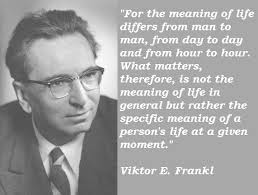
    .Viktor Frankl quotationhttp://freudsbutcher.com/psychology/viktor-kornmehl-viktor-frankl-sigmund-freud/
What Frankl concluded after enduring the horrifying suffering in the camps, even in that most absurd, painful and dehumanized situation, was that life has the potential for meaning .The concept that suffering has meaning became the strong basis for his Logo therapy . He has said, "What is to give light must endure burning."

It was in the midst of the gruesome suffering he had to endure in the Nazi camp, that he suddenly had his epiphany , the revelation that if there is meaning for life, then there must be meaning for suffering too.This thought later developed into his seminal work,'Man's Search for Meaning'. In this book he describes that moment thus :
'We stumbled on in the darkness, over big stones and through large puddles, along the one road running through the camp. The accompanying guards kept shouting at us and driving us with the butts of their rifles. Anyone with very sore feet supported himself on his neighbor's arm. Hardly a word was spoken; the icy wind did not encourage talk. Hiding his hand behind his upturned collar, the man marching next to me whispered suddenly: "If our wives could see us now! I do hope they are better off in their camps and don't know what is happening to us."
That brought thoughts of my own wife to mind. And as we stumbled on for miles, slipping on icy spots, supporting each other time and again, dragging one another on and upward, nothing was said, but we both knew: each of us was thinking of his wife. Occasionally I looked at the sky, where the stars were fading and the pink light of the morning was beginning to spread behind a dark bank of clouds. But my mind clung to my wife's image, imagining it with an uncanny acuteness. I heard her answering me, saw her smile, her frank and encouraging look. Real or not, her look then was more luminous than the sun which was beginning to rise.
A thought transfixed me: for the first time in my life I saw the truth as it is set into song by so many poets, proclaimed as the final wisdom by so many thinkers. The truth--that love is the ultimate and the highest goal to which man can aspire. Then I grasped the meaning of the greatest secret that human poetry and human thought and belief have to impart: The salvation of man is through love and in love. I understood how a man who has nothing left in this world may still know bliss, be it only for a brief moment, in the contemplation of his beloved. In a position of utter desolation, when a man cannot express himself in positive action, when his only achievement may consist in enduring his sufferings in the right way--an honorable way--in such a position man can, through loving contemplation of the image he carries of his beloved, achieve fulfillment.
For the first time in my life, I was able to understand the words, "The angels are lost in perpetual contemplation of an infinite glory." In front of me a man stumbled and those following him fell on top of him. The guard rushed over and used his whip on them all. Thus my thoughts were interrupted for a few minutes. But soon my soul found its way back from the prisoners existence to another world, and I resumed talk with my loved one: I asked her questions, and she answered; she questioned me in return, and I answered... My mind still clung to the image of my wife.
A thought crossed my mind: I didn't even know if she were still alive, and I had no means of finding out (during all my prison life there was no outgoing or incoming mail); but at that moment it ceased to matter. There was no need to know; nothing could touch the strength of my love, and the thoughts of my beloved. Had I known then that my wife was dead, I think that I still would have given myself, undisturbed by that knowledge, to the contemplation of that image, and that my mental conversation with her would have been just as vivid and just as satisfying. "Set me like a seal upon thy heart, love is as strong as death." from 'Man's Search for Meaning.'


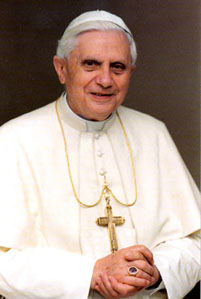
Pope Benedict XVI
Now let us compare this with the 37th section of Spe Salvi. What I find here is a step above Frankl. More than a will to meaning, here is the will to Hope!!! Not just the ordinary terrestrial level of Hope. Here is the ultimate level, that of "finding meaning in union with Christ"!!! This is what St.Paul repeatedly says in his epistles, especially in Hebrews 11 or in the classical verse, Romans 5:5: "This Hope does not disappoint us." Let me quote Section 37 of Spe Salvi here:
37. Let us return to our topic. We can try to limit suffering, to fight against it, but we cannot eliminate it. It is when we attempt to avoid suffering by withdrawing from anything that might involve hurt, when we try to spare ourselves the effort and pain of pursuing truth, love, and goodness, that we drift into a life of emptiness, in which there may be almost no pain, but the dark sensation of meaninglessness and abandonment is all the greater. It is not by sidestepping or fleeing from suffering that we are healed, but rather by our capacity for accepting it, maturing through it and finding meaning through union with Christ, who suffered with infinite love. In this context, I would like to quote a passage from a letter written by the Vietnamese martyr Paul Le-Bao-Tinh († 1857) which illustrates this transformation of suffering through the power of hope springing from faith. “I, Paul, in chains for the name of Christ, wish to relate to you the trials besetting me daily, in order that you may be inflamed with love for God and join with me in his praises, for his mercy is for ever (Ps136 [135]). The prison here is a true image of everlasting Hell: to cruel tortures of every kind—shackles, iron chains, manacles—are added hatred, vengeance, calumnies, obscene speech, quarrels, evil acts, swearing, curses, as well as anguish and grief. But the God who once freed the three children from the fiery furnace is with me always; he has delivered me from these tribulations and made them sweet, for his mercy is for ever. In the midst of these torments, which usually terrify others, I am, by the grace of God, full of joy and gladness, because I am not alone —Christ is with me ... How am I to bear with the spectacle, as each day I see emperors, mandarins, and their retinue blaspheming your holy name, O Lord, who are enthroned above the Cherubim and Seraphim? (cf. Ps 80:1 [79:2]). Behold, the pagans have trodden your Cross underfoot! Where is your glory? As I see all this, I would, in the ardent love I have for you, prefer to be torn limb from limb and to die as a witness to your love. O Lord, show your power, save me, sustain me, that in my infirmity your power may be shown and may be glorified before the nations ... Beloved brothers, as you hear all these things may you give endless thanks in joy to God, from whom every good proceeds; bless the Lord with me, for his mercy is for ever ... I write these things to you in order that your faith and mine may be united. In the midst of this storm I cast my anchor towards the throne of God, the anchor that is the lively hope in my heart”[28]. This is a letter from “Hell”. It lays bare all the horror of a concentration camp, where to the torments inflicted by tyrants upon their victims is added the outbreak of evil in the victims themselves, such that they in turn become further instruments of their persecutors' cruelty. This is indeed a letter from Hell, but it also reveals the truth of the Psalm text: “If I go up to the heavens, you are there; if I sink to the nether world, you are present there ... If I say, ‘Surely the darkness shall hide me, and night shall be my light' —for you darkness itself is not dark, and night shines as the day; darkness and light are the same” (Ps 139 [138]:8-12; cf. also Ps 23 [22]:4). Christ descended into “Hell” and is therefore close to those cast into it, transforming their darkness into light. Suffering and torment is still terrible and well- nigh unbearable. Yet the star of hope has risen—the anchor of the heart reaches the very throne of God. Instead of evil being unleashed within man, the light shines victorious: suffering—without ceasing to be suffering—becomes, despite everything, a hymn of praise.

A Few Passages from Spe Salvi


  • 14.   Indeed, the Letter to the Hebrews speaks of a “city” (cf. 11:10, 16; 12:22; 13:14) and therefore of communal salvation. Consistently with this view, sin is understood by the Fathers as the destruction of the unity of the human race, as fragmentation and division. Babel, the place where languages were confused, the place of separation, is seen to be an expression of what sin fundamentally is. Hence “redemption” appears as the reestablishment of unity, in which we come together once more in a union that begins to take shape in the world community of believers. 

  • 24    There is no doubt, therefore, that a “Kingdom of God” accomplished without God—a kingdom therefore of man alone—inevitably ends up as the “perverse end” of all things as described by Kant: we have seen it, and we see it over and over again. Yet neither is there any doubt that God truly enters into human affairs only when, rather than being present merely in our thinking, he himself comes towards us and speaks to us. Reason therefore needs faith if it is to be completely itself: reason and faith need one another in order to fulfil their true nature and their mission.

  • 27.   Man's great, true hope which holds firm in spite of all disappointments can only be God—God who has loved us and who continues to love us “to the end,” until all “is accomplished” (cf.Jn 13:1 and 19:30). Whoever is moved by love begins to perceive what “life” really is. He begins to perceive the meaning of the word of hope that we encountered in the Baptismal Rite: from faith I await “eternal life”—the true life which, whole and unthreatened, in all its fullness, is simply life. Jesus, who said that he had come so that we might have life and have it in its fullness, in abundance (cf. Jn 10:10), has also explained to us what “life” means: “this is eternal life, that they know you the only true God, and Jesus Christ whom you have sent” (Jn 17:3). Life in its true sense is not something we have exclusively in or from ourselves: it is a relationship. And life in its totality is a relationship with him who is the source of life. If we are in relation with him who does not die, who is Life itself and Love itself, then we are in life. Then we “live”.


  • 30.  Day by day, man experiences many greater or lesser hopes, different in kind according to the different periods of his life. Sometimes one of these hopes may appear to be totally satisfying without any need for other hopes. Young people can have the hope of a great and fully satisfying love; the hope of a certain position in their profession, or of some success that will prove decisive for the rest of their lives. When these hopes are fulfilled, however, it becomes clear that they were not, in reality, the whole. It becomes evident that man has need of a hope that goes further. It becomes clear that only something infinite will suffice for him, something that will always be more than he can ever attain. 


  • 31. Let us say once again: we need the greater and lesser hopes that keep us going day by day. But these are not enough without the great hope, which must surpass everything else. This great hope can only be God, who encompasses the whole of reality and who can bestow upon us what we, by ourselves, cannot attain. The fact that it comes to us as a gift is actually part of hope. God is the foundation of hope: not any god, but the God who has a human face and who has loved us to the end, each one of us and humanity in its entirety. His Kingdom is not an imaginary hereafter, situated in a future that will never arrive; his Kingdom is present wherever he is loved and wherever his love reaches us. 


Thursday, 19 September 2013

St.Joseph (Guisseppe) Moscati - the Doctor Saint!

Came to know about a 20th century doctor saint - St. Guisseppe Moscati! Watched the movie 'Guiseppe Moscati: A Doctor to the Poor'. The life story of this great Saint, "the Holy Physician of Naples" is presented so beautifully in the movie. A must watch for all Christians, especially  Christian doctors.It is said of him that he always carried a Rosary in his pocket as reminder throughout the day to be near the Bl. Virgin Mary, and it helped him to take important decisions.St. Moscati was the primary doctor to  Blessed Borto Longo, the founder of the Sanctuary of Our Lady of Pompeii 

 Here are some quotes of St.Guisseppe from
 http://www.moscati.it/English/En_pensieri.html. 
"Sick people are Jesus Christ's creatures. Many wicked people, criminals, swearers, find themselves in a hospital by God's mercy, he wants them to be saved! Nuns, doctors and nurses that work in a hospital have a mission: cooperating with this endless mercy, helping, forgiving and sacrificing themselves." [slip of paper written by Moscati, dated Jan. 17th, 1922.]
Love truth; show yourself as you are, without pretence, without fears and cares. And if the truth means your persecution, accept it; if it means your torment, bear it. And if for the truth's sake you should sacrifice yourself and your life, be strong in your sacrifice."[note written by G.Moscati on Oct. 17th, 1922.]
"I've got here, on my table, among the first flowers of Spring, one of your daughter's portrait and I rest, while writing, and meditate upon the frailty of human things. Beauty, every enchantment of life has an end…Only eternal Love lasts, the one that is the reason of every good action, that survives us, that is hope and religion, because Love is God. Satan tried to foul even earthly love, but God purified it through Death. A splendid Death which is not an end, but a beginning of the Sublime and Divine, in the presence of which these flowers and Beauty are nothing! Your Angel ravished in her young years, like her beloved friend, the Blessed Therese, discovered in her last years, assists you and her mother from Heaven…"[from a letter to the Notary De Magistris, whose daughter was dead. March 7th, 1924. G.Moscati was a devotee of the Blessed Therese of the Holy Child [St.Therese of Lisieux]. He speaks about Her in some letters and had a portrait of Her in his room. You can read an article by Giuseppe Samà s.j. about it: St Therese of Lisieux (The Little Flower) and St Joseph Moscati]
 Prayer to Saint Joseph Moscati
O Saint Joseph Moscati,
doctor with a huge heart,
in the exercise of your profession
you cured the body and spirit of your patients,
turn towards us too who now run to you
with faith in your intercession.
Give us physical and spiritual health,
so that we can serve our brothers 
with generosity.
Alleviate the pain of those that suffer,
give comfort to the sick,
consolation to the afflicted,
and hope to the hopeless.
Make that the sick might encounter
doctors like you: human and Christian.
The youth find in you a model of life,
the workers, an example, the old, comfort,
and the dying, hope in eternal salvation.
Be for all of us a sure guide:
teach us to work with serenity,
honesty and charity,
to be able to complete in a Christian way
our everyday tasks.
Saint Joseph Moscati,
pray for us!
http://www.comunitacenacolo.it/viewpagina.asp?keypagina=2643

"Remember that, following Medicine, you undertook upon yourself the responsibility of a teaching always in your memory, with love and pity for the abandoned, with faith and enthousiasm, deaf to praises and criticisms, to envry, inclined only to God."
[from a letter to Dr.Giuseppe Biondi, Sept. 4th, 1921.]


St. Joseph Moscatihttp://
/theology_heart/life_saints/st_joseph_moscati.html

"Let us daily practice charity. God is love. He who loves is in God and God in him. Let us never forget to offer every day, nay,every moment, our actions to God, doing all things for love. ... Love truth; show yourself as you are, without pretense, without fears and cares. And if the truth means your persecution, accept it; if it means your torment, bear it. And if for thetruth's sake you should sacrifice yourself and your life, be strong in your sacrifice." 

Marcelino Pan Y Vino

Wednesday, 18 September 2013

Marcelino Pan Y Vino and "I Thirst"


Marcelino, Pan y Vino
http://leelibros.com/biblioteca/index.php?q=marcelino_pan_y_vino_0

Was it a mere coincidence that I happened to watch the programme 'Movie Light 'in Goodness TV last night? The way Fr. Benny narrated the story of the Spanish movie "Marcelino Pan y Vino" ( Marcelino Bread and Wine)and the tear jerking visuals  really do make one think a little deeper on the Love of the Crucified Saviour! 
Surprisingly, it is not the usual miracle - like Jesus consoling and pacifying an abandoned orphan kid- that makes the theme of the movie . On the contrary, it is the abandoned boy who is consoling the suffering Man on the Cross. The five year old boy, who has not yet been taught who Jesus is, feels a sort of empathy towards Him, when he finds Him abandoned in the cluttered attic of the monastery, . He knows the pain of abandonment, after all! So he sets out to console and pacify the Lonely Man on the Cross in the attic! The boy feels that the Man is hungry and thirsty, and he sneaks Bread and Wine from the monastery kitchen and offers it to the Suffering Man on the Cross. By the time, the Man has also become the boy's sole Friend and Confidante!! Now comes the miracle. The statue of Jesus on the Cross comes alive. He reaches out His hand to accept the boy's bread!Later, He even comes down from the Cross to sit on the huge chair drawn to the table by the little boy.The climax of the story brings all the friars, including the superior up to the attic, as they burst out in tears - of repentance, I'm afraid! What a story! And how convincing!!!
    I thought I had forgotten all about this movie, until this  morning ,when I happened to read, rather was driven to read ( by who else but my dear Angel) the "33 Days Morning Glory" by Fr. Michael E Gaitley MIC. And there in lay the decoding of the symbolic meaning of Marcelino Pan y Vino! The true meaning of the movie lies in a letter written by Mother Teresa of Kolkota to her Missionaries of Charity, just four years before her death. She was inspired to write this letter on March 25, 1993, after reading the Lenten Message of Pope John Paul II on "I Thirst". Let me cite the whole section as Fr. Michael has done in his book:


      You all know in your mind that Jesus loves you – but in this letter Mother wants to touch           your heart instead. Jesus wants to stir up our hearts, so not to lose our early love, specially         in the future after Mother leaves you. That is why I ask you to read this letter before the            Blessed Sacrament, the same place it was written, so Jesus himself can speak to you each         one.
Why is Mother saying these things?. After reading Holy Father’s letter on "I thirst," I was struck so much – I cannot tell you what I felt. His letter made me realize more than ever how beautiful is our vocation. How great God’s love for us in choosing our Society to satiate that thirst of Jesus, for love, for souls – giving us our special place in the Church. At the same time we are reminding the world of His thirst, something that was being forgotten. I wrote Holy Father to thank him. Holy Father’s letter is a sign for our whole society – to go more into this great thirst of Jesus for each one. It is also a sign for Mother, that the time has come for me to speak openly of the gift God gave September 10 – to explain fully as I can what means for me the thirst of Jesus.For me Jesus’ thirst is something so intimate – so I have felt shy until now to speak to you of September 10 – I wanted to do as Our Lady who "kept all these things in her heart." That is why Mother hasn’t spoken so much of I Thirst, especially outside. But still, Mother’s letters and instructions always point to it – showing the means to satiate His thirst through prayer, intimacy with Jesus, living our vows – specially our 4th vow. For me it is so clear – everything in MC exists only to satiate Jesus. His words on the wall of every MC chapel, they are not from the past only, but alive here and now, spoken to you. Do you believe it? If so, you will hear, you will feel His presence. Let it become as intimate for each of you, just as for Mother – this is the greatest joy you could give me. Mother will try to help you understand – but Jesus himself must be the one to say to you "I Thirst." Hear your own name. Not just once. Every day. If you listen with your heart, you will hear, you will understand.Why does Jesus say "I Thirst"? What does it mean? Something so hard to explain in words – if you remember anything from Mother’s letter, remember this – "I thirst" is something much deeper than Jesus just saying "I love you." Until you know deep inside that Jesus thirsts for you – you can’t begin to know who He wants to be for you. Or who He wants you to be for Him.The heart and soul of MC is only this – the thirst of Jesus’ Heart, hidden in the poor. This is the source of every part of MC life. It gives us our Aim, our 4th vow, the Spirit of our Society. Satiating the living Jesus in our midst is the Society’s only purpose for existing. Can we each say the same for ourselves – that it is our only reason for living? Ask yourself – would it make any difference in my vocation, in my relation to Jesus, in my work, if Jesus’ thirst were no longer our aim – no longer on the chapel wall? Would anything change in my life? Would I feel any loss? Ask yourself honestly, and let this be a test for each to see if His thirst is a reality, something alive – not just an idea."I Thirst" and "You did it to me" – Remember always to connect the two, the means with the Aim. What God has joined together let no one split apart. Do not underestimate our practical means – the work for the poor, no matter how small or humble – that make our life something beautiful for God. They are the most precious gifts of God to our Society – Jesus’ hidden presence so near, so able to touch. Without the work for the poor the Aim dies – Jesus’ thirst is only words with no meaning, no answer. Uniting the two, our MC vocation will remain alive and real, what Our Lady asked.The thirst of Jesus is the focus of all that is MC. The Church has confirmed it again and again – "Our charism is to satiate the thirst of Jesus for love and souls – by working at the salvation and sanctification of the poorest of the poor." Nothing different. Nothing else. Let us do all we can to protect this gift of God to our Society.Believe me, my dear children – pay close attention to what Mother is saying now - only the thirst of Jesus, hearing it, feeling it, answering it with all your heart, will keep the Society alive after Mother leaves you. If this is your life, you will be all right. Even when Mother leaves you, Jesus’ thirst will never leave you. Jesus thirsting in the poor you will have with you always.That is why I want the Active Sisters and Brothers, the Contemplative Sisters and Brothers, and the Fathers to each one aid the other in satiating Jesus with their own special gift – supporting, completing each other and this precious Grace as one Family, with one Aim and purpose. Do not exclude the Coworkers and Lay MCs from this – this is their call as well, help them to know it.Because the first duty of a priest is the ministry to preach, some years back I asked our Fathers to begin speaking about I Thirst, to go more deeply into what God gave the Society September 10. I feel Jesus wants this of them, also in the future – so pray Our Lady keeps them in this special part of their 4th vow. Our Lady will help all of us in this, since she was the first person to hear Jesus’ cry I Thirst with St. John, and I am sure Mary Magdalen. Because she was there on Calvary, she knows how real, how deep His longing for you and for the poor. Do we know? Do we feel as she? Ask her to teach – you and the whole Society are hers. Her role is to bring you face to face, as John and Magdalen, with the love in the Heart of Jesus crucified. Before it was Our Lady pleading with Mother, now it is Mother, in her name pleading with you – "listen to Jesus’ thirst." Let it be for each what Holy Father said in his letter – a Word of Life.How do you approach the thirst of Jesus? Only one secret – the closer you come to Jesus, the better you will know His thirst. "Repent and believe," Jesus tells us. What are we to repent? Our indifference, our hardness of heart. What are we to believe? Jesus thirsts even now, in your heart and in the poor – He knows your weakness, He wants only your love, wants only the chance to love you. He is not bound by time. Whenever we come close to Him – we become partners of Our Lady, St. John, Magdalen. Hear Him. Hear your own name. Make my joy and yours complete.Let us pray.
     
 http://www.mcpriests.com/15legacy/varanasi.htm
Excerpts from a letter to the Missionaries of Charity, Easter, 1993.
 

http://www.saintlyquotations.com/2013/06/mother-teresa-quotation-kiss-from-cross.html

Mother Teresa: The Kiss from the Cross


Suffering has to come because if you look at the cross, he has got his head bending down - he wants to kiss you - and he has both hands open wide - he wants to embrace you. He has his heart opened wide to receive you. Then when you feel miserable inside, look at the cross and you will know what is happening. Suffering, pain, sorrow, humiliation, feelings of loneliness, are nothing but the kiss of Jesus, a sign that you have come so close that he can kiss you. Do you understand, brothers, sisters, or whoever you may be? Suffering, pain, humiliation - this is the kiss of Jesus. At times you come so close to Jesus on the cross that he can kiss you. I once told this to a lady who was suffering very much. She answered, "Tell Jesus not to kiss me - to stop kissing me." That suffering has to come that came into the life of Our Lady, that came in the life of Jesus - it has to come in our life also. Only never put on a long face. Suffering is a gift from God. It is between you and Jesus alone inside.

- Mother Teresa of Calcutta

Tuesday, 17 September 2013

Mary, the Incomparable Daughter of Zion

The Icon of Our Lady of the Sign (Greek: Panagia or Παναγία; Old Church Slavonic: Ikona Bozhey Materi "Znamenie"; Polish: Ikona Bogurodzicy "Znak" ') is the term for a particular type of icon of the Theotokos (Virgin Mary), facing the viewer directly, depicted either full length or half, with her hands raised in the oransposition, and with the image of the Child Jesus depicted within a round aureole upon her breast.  http://en.wikipedia.org/wiki/Our_Lady_of_the_Sign


I am catching up with my reading habit. But these days I prefer to read slowly, reflecting on what I am reading. It is because what I read these days is real stuff !! Yesterday I read just 20 pages of Spe Salvi by Pope Benedict XVI.(Gasp........!!! Couldn't read any more than that because of the intensity of the matter discussed there.) I especially loved the part where our dear Pope Emeritus mentions St Gregory of Nazianzen :
In this regard a text by Saint Gregory Nazianzen is enlightening. He says that at the very moment when the Magi, guided by the star, adored Christ the new king, astrology came to an end, because the stars were now moving in the orbit determined by Christ[2]. This scene, in fact, overturns the world-view of that time, which in a different way has become fashionable once again today. It is not the elemental spirits of the universe, the laws of matter, which ultimately govern the world and mankind, but a personal God governs the stars, that is, the universe; it is not the laws of matter and of evolution that have the final say, but reason, will, love—a Person. And if we know this Person and he knows us, then truly the inexorable power of material elements no longer has the last word; we are not slaves of the universe and of its laws, we are free. In ancient times, honest enquiring minds were aware of this. Heaven is not empty. Life is not a simple product of laws and the randomness of matter, but within everything and at the same time above everything, there is a personal will, there is a Spirit who in Jesus has revealed himself as Love[3]
And the next paragraph (para 6) also is quite enlightening . It is about how  the Christian art seen on the Sacrophagi of the early Christian era   illustrates the concept of  Christ as the Shepherd  Philosopher. (That reminded me also of the logo of CCC).http://idlespeculations-terryprest.blogspot.in/2007/12/philosophers-and-shepherds.htmlhttp://en.wikipedia.org/wiki/Catechism_of_the_Catholic_Church
Towards the end of the third century, on the sarcophagus of a child in Rome, we find for the first time, in the context of the resurrection of Lazarus, the figure of Christ as the true philosopher, holding the Gospel in one hand and the philosopher's travelling staff in the other. With his staff, he conquers death; the Gospel brings the truth that itinerant philosophers had searched for in vain. In this image, which then became a common feature of sarcophagus art for a long time, we see clearly what both educated and simple people found in Christ: he tells us who man truly is and what a man must do in order to be truly human. He shows us the way, and this way is the truth. He himself is both the way and the truth, and therefore he is also the life which all of us are seeking. He also shows us the way beyond death; only someone able to do this is a true teacher of life. The same thing becomes visible in the image of the shepherd. As in the representation of the philosopher, so too through the figure of the shepherd the early Church could identify with existing models of Roman art...
Now I must slowly take my time to meditate on these 20 pages.  . Meanwhile, let me  take a break from Spe Salvi !That has led me to "33 days of Morning Glory - A do-it yourself Retreat in preparation for Marian Consecration" by Michael Gaitley. But I will have to wait for a few more weeks to start the retreat because the next suitable date to start is October 19  so as to make the consecration on November 21, the feast of the Presentation of Mary.So I thought I'd just browse through the Week 4 section - Bl. John Paul II, "the most Marian Pope". I have a copy of  JP II's "Gift and  Mystery".Must read that too. And also I am thinking of taking an informal one-month retreat with Mary, my Mother. For that, I have Gabriel Amorth SSP's 'The Gospel of Mary - A Month with the Mother of God'. It must be light reading because it is about my Mother! But the first day's chapter itself has already led me to refer the 8th section of 'Lumen Gentium' -  "The Blessed Virgin Mary, Mother of God in the Mystery of Christ and the Church" 
:
 II. The Role of the Blessed Mother in the Economy of Salvation

http://taylormarshall.com/2013/03/mary-untier-of-knots-pope-francis.html
 Pope Francis has a very special devotion to Our Lady Untier of Knots. 

55. The Sacred Scriptures of both the Old and the New Testament, as well as ancient Tradition show the role of the Mother of the Saviour in the economy of salvation in an ever clearer light and draw attention to it. The books of the Old Testament describe the history of salvation, by which the coming of Christ into the world was slowly prepared. These earliest documents, as they are read in the Church and are understood in the light of a further and full revelation, bring the figure of the woman, Mother of the Redeemer, into a gradually clearer light. When it is looked at in this way, she is already prophetically foreshadowed in the promise of victory over the serpent which was given to our first parents after their fall into sin.(284) Likewise she is the Virgin who shall conceive and bear a son, whose name will be called Emmanuel.(285) She stands out among the poor and humble of the Lord, who confidently hope for and receive salvation from Him. With her the exalted Daughter of Sion, and after a long expectation of the promise, the times are fulfilled and the new Economy established, when the Son of God took a human nature from her, that He might in the mysteries of His flesh free man from sin.


56. The Father of mercies willed that the incarnation should be preceded by the acceptance of her who was predestined to be the mother of His Son, so that just as a woman contributed to death, so also a woman should contribute to life. That is true in outstanding fashion of the mother of Jesus, who gave to the world Him who is Life itself and who renews all things, and who was enriched by God with the gifts which befit such a role. It is no wonder therefore that the usage prevailed among the Fathers whereby they called the mother of God entirely holy and free from all stain of sin, as though fashioned by the Holy Spirit and formed as a new creature.(5*) Adorned from the first instant of her conception with the radiance of an entirely unique holiness, the Virgin of Nazareth is greeted, on God's command, by an angel messenger as "full of grace",(286) and to the heavenly messenger she replies: "Behold the handmaid of the Lord, be it done unto me according to thy word".(287) Thus Mary, a daughter of Adam, consenting to the divine Word, became the mother of Jesus, the one and only Mediator. Embracing God's salvific will with a full heart and impeded by no sin, she devoted herself totally as a handmaid of the Lord to the person and work of her Son, under Him and with Him, by the grace of almighty God, serving the mystery of redemption. Rightly therefore the holy Fathers see her as used by God not merely in a passive way, but as freely cooperating in the work of human salvation through faith and obedience. For, as St. Irenaeus says, she "being obedient, became the cause of salvation for herself and for the whole human race."(6*) Hence not a few of the early Fathers gladly assert in their preaching, "The knot of Eve's disobedience was untied by Mary's obedience; what the virgin Eve bound through her unbelief, the Virgin Mary loosened by her faith."(7*) Comparing Mary with Eve, they call her "the Mother of the living,"(8*) and still more often they say: "death through Eve, life through Mary."(9*)
http://www.vatican.va/archive/hist_councils/ii_vatican_council/documents/vat-ii_const_19641121_lumen-gentium_en.html
That much for today. Below are two Post Vatican Council II quotes on BVM by none else than JPII and Pope Paul VI:
" ...through the mystery of Christ, on the horizon of the Church's faith there shines in its fullness the mystery of his Mother." Bl. John Paul II in Redemptoris Mater

 The Catholic Church, endowed with centuries of experience, recognizes in devotion to the Blessed Virgin a powerful aid for man as he strives for fulfillment. Mary, the New Woman, stands at the side of Christ, the New Man, within whose mystery the mystery of man(124) alone finds true light; she is given to its as a pledge and guarantee that God's plan in Christ for the salvation of the whole man has already achieved realization in a creature: in her. Contemplated in the episodes of the Gospels and in the reality which she already possesses in the City of God, the Blessed Virgin Mary offers a calm vision and a reassuring word to modern man, torn as he often is between anguish and hope, defeated by the sense of his own limitations and assailed by limitless aspirations, troubled in his mind and divided in his heart, uncertain before the riddle of death, oppressed by loneliness while yearning for fellowship, a prey to boredom and disgust. She shows forth the victory of hope over anguish, of fellowship over solitude, of peace over anxiety, of joy and beauty over boredom and disgust, of eternal visions over earthly ones, of life over death.
- Pope Paul VI, in the concluding paragraphs of  'Marialis Cultus' 
http://www.vatican.va/holy_father/paul_vi/apost_exhortations/documents/hf_p-vi_exh_19740202_marialis-cultus_en.html